
Commercial & Industrial · 30 kW – 2 MW
PTX-2000PTX 2 MW · 2 MW / 2,057.8 kWh · ~1 h standard
Industrial system · 2 × 1 MW groups · Large HT consumer · industrial park · open-access solar · DCFC hub
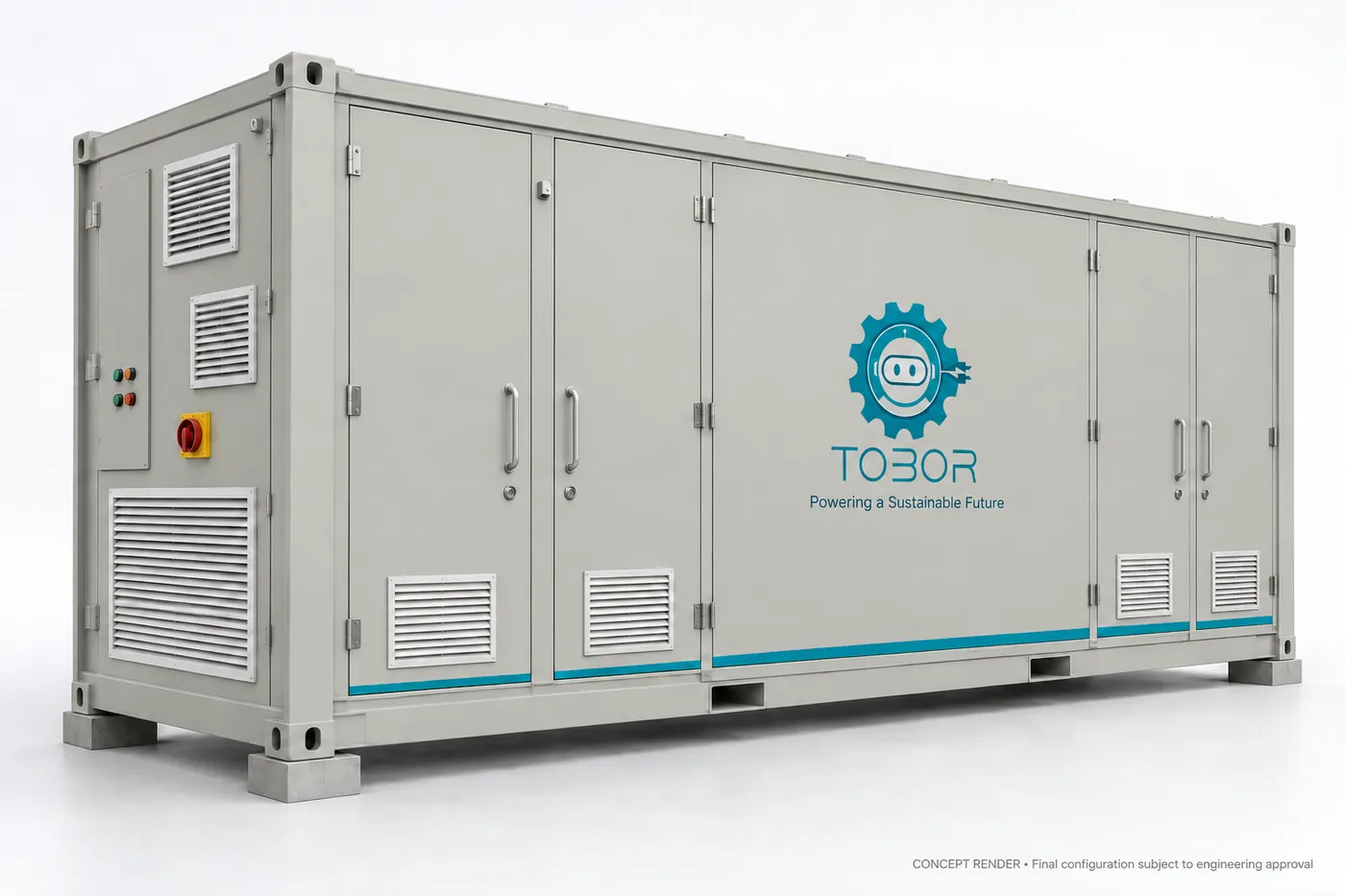
2 MW / 2.06 MWh (TOBOR BESS 2000): two 1 MW PM groups on an eight-string 314 Ah LFP battery. The top of the C&I range — for large HT consumers, industrial parks and open-access solar buyers who need two megawatts behind the meter.
Full technical sheet.
Power conversion
- Configured power2 MW · 2 × 8 PM groups
- Power module125 kW bidirectional PM
- Rated / max power per PM125 / 137.5 kW
- Rated / max current per PM181 / 200 A
- Nominal AC output400 / 230 V · 3-phase
- Grid voltage range-20% → +15%
- Frequency50 / 60 Hz
- Peak PM efficiency98.5%
- Unbalanced load100%
- Charge / discharge reversal< 20 ms
- Grid-outage transferExternal PCC switching, site-engineered
Battery
- Cell chemistryLiFePO4 (LFP) · 3.2 V · 314 Ah
- String configuration8P · 2,512 Ah
- Stored energy (1-h standard)2,057.8 kWh
- DC platform819.2 V nominal · 600–900 V window
- DC current2,441 A
- Cycle capability~8,000 cycles*
Environment & integration
- PM cooling / protectionForced air · IP20 (enclosure per site)
- Operating temp-30 °C → +60 °C (derates above 45 °C)
- PM communicationEMS RS485 · battery CAN / RS485
- AC / MV interfaceEngineered to the site
Control & monitoring
- Battery managementIn-house TOBOR BMS
- Energy managementIn-house TOBOR EMS
- Dispatch modesPeak shaving · ToU shifting · Solar self-use · Backup reserve
- Site integrationGrid · Solar PV · DG · EV charging
- Remote accessCloud EMS dashboard · remote diagnostics
Catalogue values. *Cycle capability depends on depth of discharge, C-rate, temperature and end-of-life criterion. Peak PM efficiency is not whole-system round-trip efficiency. Usable energy and runtime depend on permitted DoD, conversion losses and auxiliaries. Final ratings and compliance follow the approved project-specific offer.
Where this size fits.
Peak-demand shaving
Clip maximum-demand peaks with EMS dispatch inside battery limits. Demand-charge savings are sized from your 15-minute interval data.
Solar self-consumption
Charge from surplus rooftop or ground-mount PV and dispatch it into evening and night shifts instead of exporting at low rates.
DG-hours reduction
Carry critical loads through outages and cut generator runtime. Battery capacity is sized to the outage profile and priority loads.
BESS-buffered EV charging
Run TOBOR DC fast chargers on a smaller grid connection — the battery covers the charging peaks, the EMS coordinates both.
Other commercial & industrial models.
Small MSME · clinic · retail · 30 kVA DG replacement
MSME factory · hotel · hospital wing · 60 kVA DG replacement
Commercial rooftop solar · critical loads · 3-phase unbalanced sites
Multi-line factory · cold chain · commercial complex · EV-charging buffer
Large MSME · 200-bed hospital · IT campus · 250 kVA DG replacement
Process industry · fleet depot · commercial campus · 500 kVA DG replacement
HT industrial consumer · data-centre campus · C&I solar park
Ready to size your project?
Share your interval load data, tariff and grid limits. Our engineers return a kW / kWh sizing, dispatch logic and a techno-commercial offer.
Request quote